Well, back again after the Byzantine path my life has taken since my last post. Some team with horns on its helmets "played" on Sunday. It was such a letdown I have purged my mind and hard drives of all the stuff about that horrific display. So ... with great memories of NFL Past, here's something for you football junkies and/or those with time to kill amd who still READ ...

Still waiting for MY season to start.
I am the fan the Rams left behind. My addiction began in 1965 when I took over as Program Director of KHJ Radio in Los Angeles. Among the job perks: Six Ram season tickets. Harlan Svare was in his third and last year as the team’s head coach.
The glamour and victories of the Fifties had vanished. The Rams had plenty of tickets available to pass out to the media.
Coming from Hawaii, I thought a big time football game was the high school Thanksgiving Day Doubleheader played yearly in the old Honolulu Stadium. How old was the place? Built in 1922; by the 50s it was known as the "Termite Palace." But that didn’t hold down attendance. Crowds of over 20,000 jammed into the place, which officially held 17,500. Arch high school rivalries like Punahou vs. Kamehameha, which dates back to the 19th century, would be fought out, often in the autumn mud.
When I first moved to California in 1962, after a few months in San Bernardino, I moved to Fresno for two years. (I had seen enough of the Fresno State Bulldogs in their visits, playing the University of Hawaii. The crowds were much smaller at UH games than for the high school battles.) Roommate Frank Terry and I drove north from the San Joaquin Valley early Sunday mornings, to Kezar Stadium to watch the 49ers play under the seagulls and their droppings.
But it was the Rams that hung me up. On my first trip to Los Angeles in March of ‘62, while scouting for talent for a new radio station, I often hung out at the Gaiety Delicatessen on Vine Street. That was the gathering place for disc jockeys who were “on the beach” -– radio jargon for unemployed. One such was Bill Watson, an L.A. native who grew up in the San Fernando Valley when the Rams were the most glamorous team in the ascending sport of professional football. They won the league championship in 1951 with a team packed with future Hall of Fame players.
Watson was the perfect age to go crazy over that. He was a jock. Not just a radio deejay, he ran track for his Burbank high school. Watson raved on and on about the Los Angeles Rams the way an L. Ron Hubbard disciple proselytizes Scientology. We went to the Los Angeles Memorial Coliseum to see Watson’s idols play. I can’t remember many specific details.

Los Angeles Memorial Coliseum
The place seemed huge enough to hold the population of the island of Lanai – about 20 times over. The action on and off the field was too fast for me. But actually I identified with the Rams in many ways. They were born the same year as me, in 1937. Their record was as bad as the ratings of KHJ Boss Radio, the L.A. radio station that I joined up with in '65.
In 1966, George Allen arrived to coach the team and vowed to turn things around—fast. (He accomplished that but we actually did it even quicker. KHJ went from the cellar to the top of the L.A. radio ratings in five months. You can look it up.)
The mid-60's were energized. Indeed, "The times they were a-changin'." KHJ presented Bob Dylan at the Hollywood Bowl for his first "electric" performance. The Doors were a local house band, playing the Sunset Strip. A record company gofer and his acne’d angular teenage wife hung out at our radio station, eager to promote their first record—after changing their name from "Caesar and Cleo." They are now known as former US Congressman, the late Sony Bono and the glamorous Perpetual Diva, Cher. On KHJ the hits just kept on comin' as "Boss Radio" became a national fad. And the Rams commanded more respect as the years went by.
Longtime Rams announcer Bob Kelley – he came west with the team from Cleveland, then died of a heart attack in 1964. He was replaced on KMPC, the Rams flagship station, by a rookie play-by-play man, Dick Enberg.
At work I met people like Mick Jagger, Jimi Hendrix, the Beatles and ALL the rest while trying to play it Hollywood cool. On Sundays, five other allegedly mature men and I motored to the Los Angeles Memorial Coliseum in what was then known as Watts; now it’s usually called South Central. We’d turn over our complimentary tickets (valued at $6.00), pass through Tunnel 7, traipse up the stairs from to Row 72 and climb over people to Seats 124-129.

"Mama" Cass Elliott. RIP
Our core group of six fanatics were Mitch Fisher, Chuck Stein, (the wonderful) Bill Kelly, Milo Periichitch and one “revolving” seat for Peter Gardiner/Allen Daviau/Mama Cass or some other rock star who dug pro football, someone's guest or even my first wife, Lenore.
We'd sit down still gripping one of the world's most revolting hot dogs, a cuppa over-fizzed Coke or putrid coffee — and go berserk for four hours screaming for Merlin, Deacon and the rest of the Dee-Fense to make the big play again. And we'd holler ugly slurs at the offense (led by Roman Gabriel) when they sputtered, which happened much too often for our liking. Fisher called him “Pineapple Head,” because he was somehow “ethnic.” Between us all, in full fury, we could hit 120 decibels to express disgust at what the Rams were not doing.
L.A.'s pro football fortunes were changing fast. Previously anonymous defensive linemen became the "Fearsome Foursome." traveling to Ram home games was an adventure in the mid-60's, during the NFL season. Every Sunday always started with the same argument: Where to stop for bagels? Which delicatessen, Canter’s or Ma Gordon's? The bagels were better at Canter’s, but Ma Gordon's was the perverse alternative because the proprietor was a retired, bald professional wrestler.
Next came the debate over which route to take to the Coliseum? I was the designated driver. Why not? I had a new Cadillac Coupe DeVille. Lovin' Spoonful on the radio. KHJ – BOSS Radio. Rams gonna win today? Do You Believe In Magic? Fisher mentioned THAT title just as the song came on KHJ. The five passengers smoked unauthorized cigarettes and tried to out-bellow the navigational suggestions screamed by the others.
"Hey, man, you know Santa Barbara's screwed every time they put the 'No Left Turn' sign up on Santa Barbara, man." Puff, puff. "Hey man, take the Harbor Freeway. Stay left, cut in at the last second and come off on Figueroa. Then you got the parking lot on the right, no sweat." Toke, toke.
After the route argument was resolved we'd pull into the parking lot — and become really frustrated. We switched on the pre-game show on KMPC. We looked up and saw the rear of the press box where the program was coming from. And we waited for what seemed like forever to be shunted into the spot the Lebanese Parking Gestapo had chosen for us. It was always a space that meant waiting long after the final gun before we even got the car out of the huge lot and onto the jammed surface streets.
1966. Our second preseason opened with the traditional Los Angeles Times Annual Charity Game. The L.A. Rams vs. the Cleveland Browns. Just as I pulled into the Santa Barbara parking lot one of our gang, Chuck Stein, a sly accountant, demanded that I stop at the entrance. He got out of the car and walked up to the first parking lot attendant he encountered. Mumble, mumble. Israel-Arab Handshake. Friendly waves to one another. Chuck returned smiling. For a mere twenty dollars he had permanently ingratiated us with "The Lebanese Underground," our name for the stadium's parking crew.

Lebanese National Flag
We repeated this opening day ritual every year until the team moved to Anaheim. You know what they say, "If you wanna slide, you gotta grease."
Thereafter, for the rest of the Rams' Coliseum games we parked in just about the best spot available. It was on the sneaky little alley on the South side of the stadium, next to the old Olympic swimming pool. We'd usually end up behind the limo that brought the Mayor of Los Angeles to the games.
During the fourth quarter, the parking crew let down the chain that kept anyone from pulling into the alley. This gave Mayor Bradley, ourselves and a few others a direct shot right out of the lot. While thousands of other Ram fans were still crammed in the Coliseum aisles and tunnels or searching the lot for their cars, we were on Hoover Street and heading home. VIP, cool.
Cruisin’ through Watts, the Caddy windows wide open, we screamed with what was left of our voices: "L. A. Rams, baby! We're Number One!" We were at one with James Brown. I Feel Good!
Being a radio guy, I was impressed with one player's voice, class and intelligence during post-game interviews. He also remains my all-time favorite Ram player on the field. That's when I discovered how articulate #74 Merlin Olsen was, besides possessing a resonant radio voice and always remained a gentlemen, no matter what had transpired on the field. After his Hall of Fame career he became as fine a broadcaster as he was a defensive tackle.
During their last season in Southern California, two other Ram greats from the 60's served as color analysts for their radio broadcasts on KMPC, which continued airing the games through to the bitter end. Those former players cum announcers were Deacon Jones and Jack Snow. One of the first homemade banners ever displayed in the Coliseum read, "Deacon—for Secretary of Defense." Prophetic. In retrospect, it turned out that David Jones' Pro Football Hall of Fame career positively shines, compared with that of the actual Secretary of Defense at that time, Robert McNamara. Revelations in McNamara’s autobiography about his role in the Vietnam War qualify him for the Political Hall of Shame.
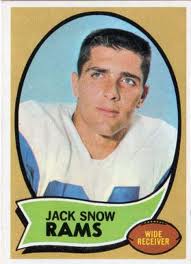
Then there was Jack Snow, whose little boy would grow up to be major league baseball standout J. T. Snow. According to Dick Enberg, then the Rams' radio play-by-play announcer, Jack Snow was “never caught from behind." In the 1960's, until Bernie Casey arrived from the 49ers, Snow was the closest thing to a deep receiving threat the Rams had. But "Bullet" Bob Hayes he was not.

"Never caught from behind!"
Each game, Snow, the All-American from Notre Dame, would somehow get open, gather in a bomb thrown up by Roman Gabriel and take off for the goal line—only to be tracked down and tackled by some speedy 49er, or Colt or Packer defensive back. This was glossed over by Enberg. The next week, it was the old, “Never caught from behind" routine by again. Ah, radio, "Theater of the mind." We guys in Row 72 really dug Enberg, so we just ignored his snow job descriptions of #84’s prowess year after year.
It was during the next-to-last game of 1967, against Green Bay, winners of Super Bowl I, that we learned a major rule: Never, ever, leave a game early. The Packers and Rams were in the same division back then. The Pack’s nefarious head coach,Vince Lombardi, symbolized all that was evil in The Universe. As usual Lombardi’s team was kicking the Rams’ butts. So with just minutes left in the season’s penultimate game and Green Bay beating the Rams who managed only a lackluster offense that day, we headed for the exit.
We nearly reached the Coupe DeVille. Following the silence of a time out we suddenly heard an ecstatic roar rise out of the Coliseum. Huddled around our portable radio we heard Enberg scream that Rams linebacker Tony Guillory had blocked a Packer punt near their own goal line. Chaos! Confusion!
Incomplete Ram pass. Then, on second down, Enberg described Gabriel’s perfect lob pass to Bernie Casey in the corner of the end zone. Touchdown! Rams win, 27-24. Riding home, we were too pissed off at our disloyalty to fully savor the victory. It was George Allen's greatest moment. And where were we? In the parking lot, listening to it on the radio. Thereafter our crew remained in our seats, even if the Rams were down by four touchdowns.
While driving away from the games, win or lose, we always listened to the post-game shows on KMPC From the very start of my Ram addiction in 1965, there was always a consistent, mysterious sound in the background of every Ram post-game locker room interview. We began to call the unknown person who made it, "The Whistler." No matter if it was a chat with Jack Pardee before the game, or an interview with Dick "Scooter" Bass after a great rushing performance, there was always one constant: The same haunting melody, whistled in the background.
We spent years trying to figure out who was doing it. Was it an equipment man, a coach, a player—what? Out best guess was that "The Whistler" was a bulwark of the offensive line, guard Joe Scibelli. He had been with the Rams since 1961. Was it just coincidence that the background whistling came to a stop in 1976, the year after the former Golden Domer Scibelli retired?
The identity of "The Whistler" was the big ongoing mystery and the subject of much debate for years, until it was replaced by a much more ominous and perplexing question: "What was the real story on the death “by drowning” of team owner Carroll Rosenbloom?”

Who killed Carroll Rosenbloom?
Superstition and voodoo. There are certain rituals we fans partake in to assure (or at least encourage) victory for the team. Well, I have a confession to make. The Rams would be undefeated right now [five games into the 1995 season, after suffering their first defeat] if it wasn't for something really stupid and masochistic I did one summer.
This story has its origins in 1967. George Allen took over as head coach of the Rams in '66 and in one season turned the team from losers to winners, just like Rich Brooks has been doing with the Rams this year. Allen inherited a seventh place team with a 4-10 record and finished the next year at 8-6. In his second year, he took the team to the old Western Conference championship game before losing to the Super Bowl-bound Green Bay Packers. Still, Allen's sophomore record was 11-1-2 . (Ties counted in those days.)
In 1967 I was still the Program Director of KHJ Radio, the job that came with six Rams season tickets. Mitchell Fisher, the first friend I made when I arrived in LA in April 1962. He also worked at the KHJ in charge of promotion, and also one of the original Boys In Row 72 who went to all the Ram home games with me.
The year before, the Rams lost the final game of the season to Vince Lombardi's fucking Green Bay Packers. In '67 it all came down to the final game of the year, against the Baltimore Colts. The Rams under Allen had played the Colts fairly even since he took over. But the Colts possessed perhaps the single most deadly offensive weapon in the NFL: Quarterback Johnny Unitas, #19.
Unitas broke our hearts as often as any opponent. And on December 17, 1967, Johnny U. was coming to town for the last regular season game. Fisher and I were young, crazy and totally committed to the Rams by then. We read in the newspapers that the Baltimore team would be staying at the Hollywood Roosevelt Hotelnear our radio station, which was located on 5515 Melrose (before that street became famous). Further, the papers said the Colts had scheduled their Friday practice at the Hollywood High School football field, a few blocks away from KHJ.
Mitch and I, both of us being "executives," decided we would wander over and heckle the Colts. We got there before the team's busses arrived. Separated by a chain link fence from the bus stop seemed to be Hairy Mammoths. We positioned ourselves just five feet away from where Unitas and his team mates would depart the vehicle and trot onto the field. The first bus pulled up and the players disembarked. Linemen appeared much bigger than they did on TV. Up close, runners and linebackers looked like Superman. Then a frail, pale guy with a crew cut and high top black shoes stepped off the bus. Hall of Fame quarterback Johnny Unitas, #19.

"How's it going, Johnny?"
We went nuts, bellowing things like: "You'll get yours Sunday, Johnny U!." "Hey, hot shot, the Fearsome Foursome is waiting to eat you alive." These exclamations were liberally sprinkled with expletives, which we felt safe shouting since we were separated from the target of our derision by that chain link fence. We felt like spectators at a zoo, jeering the dangerous beasts, hoping to not show the deep-seated secret fear we felt if the fence ever gave in. One of the NFL's earliest monster defensive linemen, Bubba Smith, glowered at us. We were harassing the great Unitas and Bubba snarled, eager to wring both our necks— simultaneously. The Colts jogged off winners. Fisher and I went back to work, knowing we had unfavorably influenced the outcome of the game in favor of Baltimore..
And, of course, we did. Final score on Sunday: George Allen's Rams 34, Johnny Unitas' Colts 10. Los Angeles finished in first place. We were on Cloud Nine—for six days—until the Rams went to Lambeau Field and were blown out by the Pack 28-7. But we had won something, first place in the division, and beat the Colts to get there and on to the playoffs.
Cut to July 15, 1995. The Rams have left California and I'm looking forward to the new season in a new city with a new coach. Believe me, after seeing most of their games at Anaheim in ‘94, both the team and the crowds couldn't have been more apathetic, drunk and lacking in knowledge of the NFL . I was ready to watch them win on satellite rather than sit there in person and watch them self-destruct.
On this July day I drove to Anaheim again, but it was to attend a big Sports Card and Memorabilia Show. (My obsession was to collect every Ram card ever issued.) These shows feature big name star, there to sign, for a fee, various items: photos, balls, bats, helmets, gloves, etc. At this show, signatures ranged from $14 (Kellen Winslow) to $135 (Magic Johnson.) In between were superstars, from Dick Butkus to Stan Musial to Juius Erving.
I spotted a beautiful magazine—Legends Sports Memorabilia, November-December 1994 issue—which featured color paintings of the Rams great "Fearsome Foursome," which Sports Illustrated had just proclaimed one of the two greatest defensive lines of all time. (The Vikings' "Purple People Eaters" were the other.) The magazine that caught my eye showed Merlin Olsen and Deacon Jones in the Rams' late-60s blue-and-white uniforms and Roosevelt Grier and Lamar Lundy in the in the early-60s blue-and-gold jerseys. The magazine was autographed by all the guys. I didn't think twice. Bought it for $90 on the spot.
Later, while sorting through thousands of cards displayed by a dealer from Houston, looking for obscure Rams, I heard an announcement on the P.A. system: "Johnny Unitas will be signing for 15 more minutes." Suddenly I flashed on all those thrilling moments in the Coliseum, the Foursome charging, Unitas standing firm in the pocket, releasing the ball at the last second.
I was under the influence of a higher pigskin power. I walked out the lobby and purchased a $30 ticket for a Unitas autograph. Looked like a computerized concert ticket. I checked out the 8x10 photos of the Hall of Fame QB on sale for five bucks each. The one I bought showed Johnny U. standing alone in a field, with trees scattered in the background. There he stands, ball cocked over his right shoulder, left arm extended, stoic look on his face. Perfect.
I walked back to the autograph area. There was Unitas, alone with one autograph dealer, signing 8x10's with a blue Sharpie pen. Like a production line, one every ten-seconds, headed for fans all over the country, completely impersonal, just a scrawled "Johnny Unitas." I strolled up and mumbled something like, "How's it going, Johnny?" Without looking up or stopping his routine, he said, "Great."
I started to blabber about how the last time I "talked" to him in was in 1967, when he was getting off the team bus at Hollywood High School. The man at Unitas' side stiffened, like I was some sort of deranged Colt-hater with a 9mm pistol in my pocket. So I quickly began to ooze things like, "Hey, John, you were the greatest the Rams ever had to play against. Remember those games in the old Coliseum?"
Unitas, who had huge, gnarled hands and sported a large gold ring, actually stopped and looked up. His companion relaxed. The great quarterback looked up at me and said, "Yeah, those were good times." I asked him if he would write something personal on my picture. "Sure," he said, "what should I put?”
My mind froze. All I could remember was this immortal passer in the white helmet with the blue horseshoe on it. I recalled how many times we drove away from the Coliseum disconsolate because Unitas had whipped the Rams on the last series of the game. How unstoppable he was. Meanwhile, Unitas strained at me. So I blurted out my request.
Now, I have the photo, neatly framed, on the wall right next to the Fearsome Foursome magazine cover. It's a great metaphor. Four monsters trying to claw their way at him, while the legendary QB stands there with impunity, poised to burn the Rams secondary. That's cool. I could start a sports bar with the other stuff on the walls: Autographed Jerome Bettis picture, 1994 Rams Throwback poster, etc.
It's just the inscription on the Unitas photo that I KNOW personally cost the Rams to lose their one game so far. By three points at that. Forget Marshall Faulk ripping off those long runs. Don't blame Johnny Bailey and Todd Kinchen for dropping key passes. Un-unh. Blame ME, the guy with the picture of the greatest Colt of all-time up there on my wall. And written in bright blue ink, "To R.J. — Loved Beating Those Rams. Johnny Unitas. July 15,1995."
Since this is being written after the 1995 Ram-Bear game, it's an appropriate time to recall some previous meetings between the two original pro teams. But first some background. The Cleveland Rams fifth game in franchise history was played against the Chicago Bears on October 10, 1937. The week before, the Rams took on the Windy City's other team, the Chicago Cardinals, which as readers of this journal surely know, would become the St. Louis Cardinals in 1960. In the Rams' inaugural year, they lost to the two Chicago teams by a combined score of 26-2.

Ditka. #89.
So you see, the Ram's rivalry with both the Bears goes way back. But, the 1985 Chicago Bears, coached by Mike Ditka, have Super Bowl rings to show for those 58 years. The closest the Rams have come to winning it all, since their 1951 pre-merger NFL championship, was on January 20, 1980 at the Rose Bowl. They would win Super Bowl XIX in the 1999 season. Also time ran out in the third quarter, the Rams led the Pittsburgh Steelers 19-17 in Super Bowl XIV. Sorry, but I have a permanent mental block about the remainder of that game. (However, I do suffer recurring nightmares of John Stallworth running wild with Terry Bradshaw passes.)
Back to 1995's fourth opponent. I remember many things from watching Ram-Bear battles in the L. A. Coliseum from high up in Row 72. Consider the second game of the 1965 season. Ram owner Dan Reeves (not the ex-Cowboy who also coached the Giants, but the Real Dan Reeves), had stolen away defensive genius, coach George Allen from the Bears to coach his team. "Papa Bear" George Halas, the Chicago team’s founder—and coach spanning 34 years—was enraged. He complained to the league office and threatened to sue the Rams. George Allen had directed the Bear defense, winning recognition in 1953, the year Chicago won the NFL title with its strong D. After that championship game, the players carried Allen, not Halas, off the field.
As Halas' protégé, it was assumed Allen would take over when the Old Man retired. But George Halas seemed destined to coach until he died—he kept doing it until the age of 72—so Allen left to become head coach of the Los Angeles Rams. Southland fans were still reeling from Harland Svare's previous three seasons as head coach, during which he won 13 games and lost 41. We didn't know it, but George Allen was about to turn a 4-10 team around in one year, going to 8-6 in his first season as head coach of the Rams.
The first game between teacher Halas and pupil Allen was a long-awaited, much-hyped affair. The previous week, the Rams lost their first game under Allen on the road against the Detroit Lions. The Rams were shut out 20-0. Didn't score a point. No one gave L. A. a chance in their next game, the home opener against Halas' "Monsters of the Midway." When the Bears hit town for the September 26, 1965 match up of mentor versus disciple, Chicago was still employing George Allen's ferocious defense.
In those days, the Bears wore jerseys with very small numbers. I guess Halas didn't think TV would last. But no one needed a "#51" to spot Dick Butkus. Greatest middle linebacker I ever saw. On offense there was #40, the immortal runner Gale Sayers. The day everyone had been waiting for arrived at last. Los Angeles held its breath. What revenge would Halas extract on his mutinous former disciple?
The Old Man, who always wore a rumpled dark suit, stalked the sidelines. George Allen, who during games always appeared on the verge of a massive heart attack, implored his new Ram team to shut down the Bears. The Ram defensive line—not yet christened the "Fearsome Foursome"—help hold Chicago to 28 points. Somehow, the Rams scored two more than that. Halas, sulked off the field. In Row 72, we went nuts. Los Angeles finally had a winner.
The next year, during a Bear game in the Coliseum, a spectator did the stupidest thing a fan can do: He jumped onto the field in an attempt to prance 100 yards across it to impress his friends and the huge crowd. (It was the late-60s, who knows what substances he consumed before this act of madness?)
Starting in the West end zone, this kid pranced around the Ram defense, which looked on bemused. The officials stood in place, hands on hips, waiting for the folly to finish. The fool thought he had it made—he merely had to dance past the team in the blue jerseys with the orange trim. As he ran by the Bear huddle, a very big guy with a very small "89" on his jersey leaned out of the Chicago huddle and delivered a forearm smash to the throat of the poor fan who had been running at full speed. The victim dropped like a Scud missile. Yes, Bear tight end Mike Ditka—who played even tougher than he talks—had knocked the interloper out cold. The game was delayed for what seemed like an hour, as the crowed booed deafeningly each time the Bears lined up to resume play.
Then, there was the most surrealistic series of downs I've ever seen in an NFL game. It happened when the Rams were played the Bears in the Coliseum in 1968. By then, Los Angles was a serious contender in the old Western Division. They would finish the season in second place with a 10-3-1 record. But—it would have been 11-2-1 and possibly first place, but for the last Ram offensive series of the game. Los Angeles was just inside Chicago territory, trailing 17-16, with little time remaining.
Quarterback Roman Gabriel, in his blue-and-white #18 jersey, stood back in the pocket and tossed three long passes into the Bear end zone, all tantalizingly close, all incomplete. Then, with seconds left in the game, the offense trotted off the field and the Bears ran out the clock.
Only my friend Bill Kelly spotted it instantly. "Fourth down, fourth down!" he screamed. The Rams radio announcer, Dick Enberg, didn't notice anything odd. The P. A. announcer merely announced, "First down, Chicago." I focused my Bushnell wide-angle Rangemaster binoculars on the Ram bench in front of us. The players and coaches were hanging their heads. I swear we weren't hallucinating. It was "Three and REALLY out."
Even though L. A. was the capital of the psychedelic world at the time, I swear this TRULY happened. An NFL professional football team's pivotal game of their season, threw three diffused bombs into the Chicago Bear end zone—-and left the field. Bears 17, Rams 16. Remember that the next time you hear about George Allen, stickler for details and coaching “genius.”