Tampilkan postingan dengan label Ron Jacobs. Tampilkan semua postingan

Kamis, 05 Januari 2012

CAMERON CROWE 40 YEARS LATER


It seems that every jag off of a certain demographic wants to be some aspect of Cameron Crowe, whose talent erupted in sync with the rhythms of the times and the trends in technology.

Had he been born in Ancient Rome, young Cameron would have been chasing around Caesar’s gardens using his wit and love of the arts to ingratiate him with those who created it, and from whom he could get a breathless, exclusive interview.

Once I was a Wunderkind. Unless one has been through the barrage of expectations that increase with success at an early age, it is difficult to understand the yin-yang attached to being really famous in a world when once “almost well-known” was more than enough.

Forty years ago, Cameron walked into my office at KGB Radio-San Diego accompanied by two other hippies with chips on their shoulders. This long-haired barefoot trio showed up at the radio station to tell us what “the people” wanted — make that, needed — on and from the radio. I represented the corporate rats that stood in their way. At least that was my POV sitting there at the programming helm of the most messed-up radio station I’d ever signed up with in a town that everyone envied for its surf, sea and sun. All of this was manini kine stuff to me, born as I was in Waikiki where the real watermen of the Pacific dwell in the swells, and so many other sights and scenes are unknown in what was then billing itself as “America’s Finest City.”

To me San Diego was the anal sphincter of California in many ways. But one of my treasured memories is of watching the shifty-eyed kid who seemed to know more than he should about life and music for a high-school kid emerging from his nerd cocoon. Cameron hung around and our mutual passions bridged the age gap. I was 35-years-old and at the top of my professional heap: rock’n’roll radio. Cameron was a 15-year-old kid who wanted to snuggle up to Led Zeppelin albums until he could meet the group live and in person and live to tell the world the rest of the story.

In Pidgin English — the street slang of my hometown of Honolulu — Cameron would be called the “Sly Mongoose” type. His intellect and curiosity expanded like a sumo belly, overflowing with torrents of words that made you wonder: Is this kid writing that stuff? Mozart and cats like that have always confounded their elders but those were unwired days. Cameron plugged into and played back his way so far and so fast that the only way I could describe it as an observer would require my lapsing into sports writing clichés.

Many of the wannabe moviemakers now unleashed and unrestrained online write about an artist’s work as if they know or knew the person directly and they hold the key to revelations held within the world as seen through film.

I need not waste one word on those straining their brains to match words and wits, syntax and insight with a master such as Cameron, whose life is multi-faceted in ways that those who “analyze” his films cannot grasp.

To paraphrase the old Rough Rider himself — Theodore Roosevelt in his famous “Man in the Arena” pronouncement: those who don’t jump in and DO IT can go sit back and fuck themselves.”

While making movies and not measuring his mark in the intervals between doing so, Cameron whizzed through more life changes than a cartoon super hero. As Joe South once wrote and Elvis echoed: “Walk a Mile in My Shoes.”

Making movies is like fighting a war and those involved should be cheered for getting out of there alive. When the paying customers emerge from the theater with a smile or a tear it makes it all worth it. Here's a shove your way Cameron: Congratulations and check back sometime during the next forty years

Selasa, 29 November 2011

ALOHA AHMET

The Biggest Kahuna

Everyone's been buzzing about the new biography of Ahmet Ertegun, released earlier this month: The Last Sultan: The Life and Times of Ahmet Ertegun by Robert Greenfield. Amazing Amazon lets you search to see if you are in a book! DNS (Digital Narcissism Syndrome.) Let's face it: who does not do that thing first off with the arrival of a book and new ink smell?

There are two paragraphs about how our KHJ "exclusives" had radio people from all over the country screaming at him and Atlantic. He always acknowledged that KHJ launched Sonny & Cher just after they were Caesar & Cleo. Ahmet mentions Bill Drake once "because he was fun to drink with" or some such.

When Charlie Greene and Brian Stone took me with them to NYC at the peak of the S&C craze; FIVE hits on Billboard charts. We spent a week a week at The Plaza and who knows how much those guys spent in Manhattan’s jewelry district alone. Not to mention wine-women-and-song.

Or how Nesuhi Ertegun and I were the only haole (Caucasians) at the debut introduction of American Top 40, which Tom Rounds and I crashed as unregistered guerrilla ops. We had snuck into a convention in Majorca in the summer of 1970 and did our pitch (using Wollensak tape recorder in the basement of a little Catholic church with a handful of young girl students in their uniforms our audience. The name Casey Kasem might have been only thing that they could comprehend. To them it probably sounded like a food dish.

Ahmet was most intense genius record guy I ever knew. And he always credited KHJ and his hours drinking with Drake at Martoni's for much of Atlantic Records mid-60’s rise to the top.

This excerpt is from my book KHJ: Inside Boss Radio (2002.)


Sonny & Cher and The Real Don Steele. KHJ 1965.

Ron Jacobs: In the beginning, we had no superstar group to endorse the station by association. When I arrived from Honolulu in 1965 a friend from there, Judy Moll, told me that her bosses Charlie Greene and Brian Stone were down to selling their office equipment to keep going. So, Caesar & Cleo became Sonny & Cher. We did little promotions and they would do whatever we asked them to do. Sonny was confident that if he just came up with something good, KHJ would give his record his shot.

Sonny Bono: Actually, the song came to me quickly, as did most of my songs. Sitting at the kitchen table, I began scribbling lyrics on the back of a sheet of cardboard from some laundry just back from the cleaners. When it was half done, and I completed the song in about an hour, I sprung it on Cher, who grabbed the cardboard from the piano and grinned, “I’m going to save this forever.”

Sometimes you write a song and don’t think much of it. Then, surprise, it explodes. But other times, you know absolutely that the song is solid gold, waiting to happen. That’s the enthusiasm Cher and I had about, “I Got You Babe.” We couldn’t race to the studio fast enough. At the sessions, the electricity flowed at even higher voltage. Everybody from Charlie and Brian to our pianist, Leon Russell, was blown away. When everyone, from the artists to the writers to the musicians on down to the studio receptionist can’t stop singing and dancing when hearing a song being created, it’s amazing! But Ahmet Ertegun, head of the record company, disagreed on which song to release as the single. He really loved, “It’s Gonna Rain.” I liked, “I Got You Babe.” I tried to persuade him otherwise, but he wouldn’t change his opinion. After arguing unsuccessfully with Ahmet, I decided to go out on a limb and prove I was right. Atco was already promoting “Rain” when I cut acetate of “Babe.”

Charlie Greene: I remember the first time I heard “I Got You Babe” coming out of KHJ. Shit, man, it sounded so fucking good. It sounded incredible and that was it, the ballgame was over. The next day it virtually was a hit. The KHJ switchboard lit up and we weren’t doing it! We had everybody ready to start calling in when they heard it, you know, everybody call. But we couldn’t get through to the switchboard, man. KHJ was getting absolutely swamped with requests. Sonny and Cher became the Beatles of Boss Radio, so to speak. They would come down to the station whenever KHJ wanted them to. Any time. We would do all kinds of shtick ’cause Jacobs was coming up with new ideas that somehow included Sonny and Cher. They were impressed with everything about the station. Loved The Real Don Steele. I mean, they were happening and Boss Radio was happening. It all broke loose with KHJ, I’m telling you. There’s no question about it. As far as I’m concerned, KHJ helped make, or made, Sonny and Cher.

Ron Jacobs: And so Sonny and Cher — of course it was really Charlie — were standing by with a bunch of people ready to call KHJ the first time we played the record. The lines lit up so much legit that their callers couldn’t even get through! So Charlie and Brian and Sonny were going nuts and all of a sudden, ba-boom!

And KHJ went all out to establish the Sonny & Cher-Boss Radio connection. We commissioned Sandy Barron, the hip graphics designer, to do a special KHJ Sonny & Cher-KHJ logo and we ran those on bus benches all around town, you know, the kind that advertise funeral homes. Sure, “I Got You Babe” was a dynamite commercial hit. But the big push nationally came after KHJ got on the record. And that happened only because Sonny Bono and Charlie Greene would not take “no” for an answer. And, I like to think, because Drake and Jacobs could hear a hit.

Dexter Young: I remember when Sonny and Cher came to the studio to do on-air interviews. Jacobs had brought them directly from LAX where they had just returned from a European tour. Jacobs asked Sonny to get rid of a briefcase he was carrying and he said no, that it contained the cash, their percentage from the European tour.

Ron Jacobs: In the beginning, we had no superstar group to endorse the station by association. Judy Moll told me that her bosses Charlie Greene and Brian Stone were down to selling their office equipment to keep going. So, Caesar & Cleo became Sonny & Cher. We did little promotions and they would do whatever we asked them to do. Sonny was confident that if he just came up with something good, KHJ would give his record his shot.

Sonny Bono: Actually, the song came to me quickly, as did most of my songs. Sitting at the kitchen table, I began scribbling lyrics on the back of a sheet of cardboard from some laundry just back from the cleaners. When it was half done, and I completed the song in about an hour, I sprung it on Cher, who grabbed the cardboard from the piano and grinned, “I’m going to save this forever.”

Sometimes you write a song and don’t think much of it. Then, surprise, it explodes. But other times, you know absolutely that the song is solid gold, waiting to happen. That’s the enthusiasm Cher and I had about, “I Got You Babe.” We couldn’t race to the studio fast enough. At the sessions, the electricity flowed at even higher voltage. Everybody from Charlie and Brian to our pianist, Leon Russell, was blown away. When everyone, from the artists to the writers to the musicians on down to the studio receptionist can’t stop singing and dancing when hearing a song being created, it’s amazing! But Ahmet Ertegun, head of the record company, disagreed on which song to release as the single. He really loved, “It’s Gonna Rain.” I liked, “I Got You Babe.” I tried to persuade him otherwise, but he wouldn’t change his opinion. After arguing unsuccessfully with Ahmet, I decided to go out on a limb and prove I was right. Atco was already promoting “Rain” when I cut acetate of “Babe.”

Charlie Greene: I remember the first time I heard “I Got You Babe” coming out of KHJ. Shit, man, it sounded so fucking good. It sounded incredible and that was it, the ballgame was over. The next day it virtually was a hit. The KHJ switchboard lit up and we weren’t doing it! We had everybody ready to start calling in when they heard it, you know, everybody call. But we couldn’t get through to the switchboard, man. KHJ was getting absolutely swamped with requests. Sonny and Cher became the Beatles of Boss Radio, so to speak. They would come down to the station whenever KHJ wanted them to. Any time. We would do all kinds of shtick ’cause Jacobs was coming up with new ideas that somehow included Sonny and Cher. They were impressed with everything about the station. Loved The Real Don Steele. I mean, they were happening and Boss Radio was happening. It all broke loose with KHJ, I’m telling you. There’s no question about it. As far as I’m concerned, KHJ helped make, or made, Sonny and Cher.

Ron Jacobs: And so Sonny and Cher — of course it was really Charlie — were standing by with a bunch of people ready to call KHJ the first time we played the record. The lines lit up so much legit that their callers couldn’t even get through! So Charlie and Brian and Sonny were going nuts and all of a sudden, ba-boom!

And KHJ went all out to establish the Sonny & Cher-Boss Radio connection. We commissioned Sandy Barron, the hip graphics designer, to do a special KHJ Sonny & Cher-KHJ logo and we ran those on bus benches all around town, you know, the kind that advertise funeral homes. Sure, “I Got You Babe” was a dynamite commercial hit. But the big push nationally came after KHJ got on the record. And that happened only because Sonny Bono and Charlie Greene would not take “no” for an answer. And, I like to think, because Drake and Jacobs could hear a hit.

Dexter Young: I remember when Sonny and Cher came to the studio to do on-air interviews. Jacobs had brought them directly from LAX where they had just returned from a European tour. Jacobs asked Sonny to get rid of a briefcase he was carrying and he said no, that it contained the cash, their percentage from the European tour.

Kamis, 24 Maret 2011

ALL NIGHT ON THE ALA WAI


In April of 1955, while doing the all-night show, KHON disc jockey Art Bogard was busted by the Honolulu Police Department's vice squad. Charged with possession of "marihuana," how it was spelled in those days, he was given the choice of catching the first plane out of town or being booked and arrested.

Bogard played "Mixed Emotions" by Rosemary Clooney, packed it in at 6 a.m. and took off for Los Angeles.

Since I was "experienced" and worked for peanuts I became a professional radio person. Being the smallest fish in the smallest broadcast pond in the Pacific mattered not. I had one bare foot in the door. Thus began my broadcast "education."

In its nine years of operation KHON went from an enterprise charged with good will and great expectations to the bottom of what was then an eight-station barrel.

KHON was sold long ago by the idealists who built it. When the station opened in 1946 the Honolulu Star-Bulletin ran a story about Ralph Fitkin headlined, "New Radio Company's President is Son of Man Fabulous in U. S. Finance."

"The elder Fitkin, who started his career as an ordained Methodist minister, was a donor of several million dollars to philanthropy," the Bulletin reported. Well, neither prayer nor the family fortune could make a go of KHON.

A series of inept owners and silly format decisions took the station further down. By February 1954, the station was sold to B. R. Gardner, a mainland car dealer. More about him later.

When I was a 9-year-old kid prowling Waikiki I investigated this radio station located across from the canal at 1701 Ala Wai Boulevard. A corrugated tin-roofed shed ran along the back wall of the parking lot. Covered spaces were reserved for staff members. The choice stall was labeled "Aku." That's what it said on the plates of his new Caddy: AKU. From the mid-1940s J. Akuhead Pupule was the superstar of Hawaiian radio. The cigarette machine in the KHON lobby was stocked exclusively with Old Gold cigarettes, a loyal Aku sponsor.

The huge record library was crammed with neatly filed 78 rpm records sheathed in light-green, heavy paper sleeves (or "shucks" as they were called.) A single, giant monophonic speaker cabinet hung on the wall above a two-speed turntable.

During one summer on a kids’ expedition I toured the grand studios of Hawaii’s oldest station, KGU. The walls of this NBC affiliate were covered with lauhala matting. The dried, woven grass was attractive in a Polynesian way and served an acoustic purpose.

KGMB's modern facilities, appropriately shipshape for a CBS outlet, and the small but tidy KIKI broadcast booths were familiar to me from my experience doing teenage shows. But I wasn't ready for how bedraggled KHON had become by 1955.

Electronic components were replaced with cannibalized replacement parts. The weird canec walls were indented or missing large chunks of the stuff, which was made from the remains of burnt sugar cane. It was, indeed, a "previously owned" radio station.

B. R. "Brick" Gardner, the station owner, usually satisfied his alcoholic cravings while I did my "shift" from midnight to 6 o'clock in the morning. He often stopped by to inspect his station when the Waikiki bars shut down at 2 a.m.

I could deal with the drunken man's stumbling, burbling and stinking of booze. What transformed the scene into a surrealistic horror show were the actions of Gardner's spastic dog. It was one of those little, allegedly "cute," snippety canines. I didn’t know the animal’s name. It might have well been Little Shit Face.

There I was, trying to stay awake while playing music designed to lull insomniacs to sleep: Mantovani, Andre Kostelanetz, Stanley Black and other unctuous crap. The studio door would fly open without warning. In charged the inebriated Gardner, followed by his slurping, yapping, uncontrollable pet.

The dog’s cute tricks included nipping at me, farting wetly and pissing on everything. Then the mutt zeroed in on the turntable that was playing the disc on the air. The tiny monster jumped up on the cabinet, chased the spinning record and dragged the needle across the grooves.


This made that horrible noise—screeeeeeech—worse than fingernails raking a blackboard or the Terminatrix’s death grinds when she finally gets hers in “T3: Rise of the Machines.” The dozen or so KHON listeners blamed the racket on the operator, me, of course.

What could I do? Ring the dog's pencil neck and toss its owner into the Ala Wai Canal? That would leave me unemployed. It might be worth it just to watch Gardner go on the air drunk, alone in the studio with a dead dog. Unfortunately, the man was so intoxicated he couldn't tell the difference between "dead air" and whatever was (or wasn't) ringing in his stupefied ears.

So, I shrugged, cued up Jackie Gleason's “Music, Martinis & Memories,” featuring Bobby Hackett on trumpet, and prayed that man and beast would leave without an olfactory trace. But oh no. Often a reminder of their visit remained, nauseating the morning man with the odor of human vomit and/or dog dung.

It did not take long to realize that "Show Biz" was not all that charismatic.

# # #

There were several reasons why the KHON job appealed to me:


(1) I "learned while I earned." Dropping out of school fueled my desire to keep up with my erstwhile Punahou and Roosevelt classmates.

(2) Virtually all those kids would head for college in the fall, to prestigious Mainland schools. Some of the RHS kids, unable to afford even the University of Hawaii, would go off to work.

(3) Although I was paid only two bucks an hour, I was living with my parents in the new Aina Haina subdivision; I had little or no expenses. I traded in my 1932 Plymouth for a suitably "hep" vehicle, my first flashy car, a 1951 Pontiac Catalina convertible. After $50 car payments I still had money to throw around. A chocolate malt and a cheeseburger at Kau Kau Korner cost less than a buck. A bowl of saimin was 20-cents.

(4) While the dreary album tracks segued until sunrise I poked around office trash and shuffled through desk drawers and file cabinets to fathom the off-air aspects of broadcasting.

(5) I read talent contracts, purchase orders, advertising agreements, FCC communications, personnel memos, incoming résumés, management directives, engineering data, etc.

Combining (1) and (3), I reasoned, gave me the jump on (6), the major priority.

Ah yes, item (6), becoming a deejay and therefore getting girls.


In his autobiography, “Growing Up,” columnist Russell Baker, describes how, as a 19-year-old virgin and Navy cadet training in Pensacola, Florida, he overheard the experienced pilots discussing their manly exploits.

"...The madness of the mania clamped me in a terrible grip. This was inflamed to a white heat by the tales told by the Casanovas who infested the barracks.

"Listening to the talk I was paralyzed with envy and desire. There is scarcely a woman alive, it seemed, who could resist the urge to haul men down onto beds, car seats, kitchen floors, dining-room tables, park grass, parlor sofas, or packing crates, entwine warm thighs around them and pant in ecstasy."

This I also believed. At seventeen I took as Gospel the veteran deejays’ tales of sexual conquest. These were initiated, if these scoundrels were to be believed, by contact made with nymphomaniacs who wore out their scarlet nails dialing the KHON' request lines. These harlots panted seductive suggestions to the mellifluous-voiced (albeit sometimes homely and/or deformed) announcers.

My professional goals and steaming testosterone level quickly made (6) my top priority. Those adolescent cramped, groveling sessions while parked at Mount Tantalus above Honolulu's city lights, or "necking" at the Diamond Head Lookout watching the “submarine races” were over. I was, after all, a professional radioman. The perquisites that accompanied my status were there for the taking.

Soon enough, doing the all-night show, twisting "pots" (volume control knobs, technically called rotary step attenuators, in the RCA "teardrop" style) and throwing switches was neither novel nor gratifying. It was time for extra-curricular job benefits.

I was ready to move beyond operating "the board" (control console) and meet a torrid wahine caller. Most were Navy wives whose husbands had been out to sea long enough to make these women urgently crave male companionship.

Or so they claimed. The ladies requested tunes like Les Baxter's “Unchained Melody,” Joan Weber’s “Let Me Go Lover” or other romantic, pre-rock songs popular in the spring of 1955. Protracted phone conversations slowly segued from song solicitation to discussions of loneliness.

These "I-just-love-the-sound-of-your-voice, Honey," phone calls were precursors of today’s phone sex. Some women talked provocatively then waited while I introduced the next song; there were little or no commercials on the overnight shift. The simmering venting of restless lust resumed. The woman breathed louder and quicker, let loose a shuddering gasp, and then—hung up. I guess I served her purpose, but those sessions left me hot and bonered, staring at plastic knobs.

I decided to "qualify" female callers until I would encounter one ready to put her mouth where her sensual thoughts were. Logistically, I knew that I would have to find the proper rendezvous to meet my first amorous accomplice. Teenage longings notwithstanding, visions of headlines like "Local Deejay Shot By Enraged Navy Husband," encouraged me to be sensible.

The country had already been caught with its pants down at Pearl Harbor. I knew better than to tempt fate and allow the same thing happen to me.


Finally, I spent one night in a teasing dialog with a Chief Petty Officer's wife possessing the sexiest voice ever heard on a request line. She claimed to unfulfilled, dripping desire, not just for anyone, but for me. I arranged an assignation.

I was not anxious to cause my parents simultaneous heart attacks followed by a grim scene with me and my stuff thrown out onto Papai Street. What proof had I that the woman's husband was indeed serving our country, bobbing in a battleship somewhere in Subic Bay? I planned visual recognizance to check things out.

Mister Cool I was not as 6 a.m. and the “New Filipino Mabuhay Hour” approached. Based on the past hours’ burning banter all I could think off was my initiation into the world of the real disc jockey.

I was out the back door seconds after I gave the hourly I.D. Inflamed by visions of what awaited I jumped into my bright red Pontiac ragtop. Rubber smoked as I roared out of the parking lot. I raced up Kalakaua Avenue, turned ewa on Kapiolani Boulevard and headed for the designated gas station at Pensacola Street. I did a racing skid into the parking area, jammed on the brakes, rolled to a silent stop and—there it was! As promised, the 1948 green Dodge coupe.

My dream was about to come true. I was ready to encounter—a woman, not a girly-girl—a genuine woman. One who possessed a throaty, irresistible voice and whose words matched mine, urge for urge.

There, in the shade, following instructions was her car. Inside, the silhouette of the female I was about to hurl myself at.

I nonchalanted my way towards the car. It was painted Navy battleship gray. Which triggered a flash of un-American guilt. But that lasted no more than a second or two.

I pulled open the car door. My first reaction was that I had entered a rolling brewery. The auto's interior stank of alcohol, which was not or has ever been my thing. Then a saw her.

Too late. I realized that the radio thing works both ways. The women who fantasize about what a jock looks like based on the sound of his voice are no different from the salacious hustlers disguised as radio announcers who prey upon their sultry sounding female callers.

I was face-to-face with the anti-Marilyn Monroe. Jayne Mansfield in a fun house mirror. Brigitte Bardot blown up as big as a Macy's Thanksgiving Day Parade balloon.

As I sank into the passenger's seat, I saw that the woman was not only old—make that antediluvian in my teenage eyes and grotesque—she was also very drunk. Then she lurched at me and vomited in my lap.

Wishing it were a nightmare I could wash away, I ran towards the water hose and drenched myself. The alcoholic adulteress hung halfway out the port side of her car, gargling incoherently.

I drove off, ardor cooled, fantasy unsatisfied, clothes soaked.

It was back to Square One. Like the defecating dog scenes, it proved indeed that "Show Biz" was not all that charismatic.

I like to think that I learned from my mistakes. Thereafter, I would instruct a “date” to drive to a brightly lit gas station. If what I saw brought back memories of the Pensacola Puke I kept on driving. It left me lacking in gratification but it saved on dry cleaning bills.

# # #

Two decades pass.

After serving my time in Los Angeles radio I returned home in 1976. I realized that I would never catch up on what happened while I was gone, what happened to whom. But one day I was talking with Tom Moffatt. We first worked together at KGU in 1956. I asked Moffatt about Gardner, where’d he end up? Moffatt replied, “You didn’t hear about the fall?” Moffatt wasn’t certain of the details.

The story was bizarre enough to send me to the Hawaii State Library Archives in downtown Honolulu.

Gardner's propensity for nocturnal prowling had finally come to a fatal conclusion. Booze is not mentioned in the following account but I bet it was involved:

Hotel Fall Kills Kahala Man, 60

A school teacher fell to his death today from the ninth floor of the Kahala Hilton Hotel. Police believe Bryson Ross Garner 60, of 4788 Aukai Avenue, Waialae-Kahala, lost his balance and toppled off a beam connecting two balconies while trying to reach an acquaintance's room.

He fell 104 feet and landed on the sidewalk. He died instantly. His was the first fatal fall at the hotel. There were no known witnesses to the 12:18 a.m. fall.

Police believe Gardner was on the ninth floor to visit a friend whose room is on that floor.

Gardner had taught at Kalakaua Intermediate School since 1960.

Gardner formerly owned radio stations here and on the Big Island. His Honolulu station was KHON, now KPOI.

Before he moved to Hawaii in 1954, he owned a chemical firm and an automobile dealership in Tacoma, Washington.

# # #

A picture of the balding, old night crawler, looking dour and wearing a prim bow tie, accompanies this front-page story from the Honolulu Star-Bulletin of January 25, 1966. This is doubtless the way he was known to his students. (Since the photo is in black and white, there is no way of determining whether his eyes were bloodshot.)

In a morbid way, Gardner was lucky he did not survive his final late night adventure. Explaining to his students—or anyone else for that matter—-his odd way of reaching the room next door might have been a bit, er, awkward. In Honolulu's gossipy radio circle, it was rumored that Gardner's "acquaintance" was another man.

The next day's Honolulu Advertiser account of the odd event lists the age of my former boss and tormentor as 57, not 60.

Neither newspaper's account of the plunge mentions whether Gardner's faithful dog took the fall with him.

Damn.

Excerpted FROM DOO-WOP TO DUOPOLY
copyright 1988-2011 Ron Jacobs.

Minggu, 27 Februari 2011

RADIO ARCHAEOLOGY ~ ROCKIN' THE ROCK

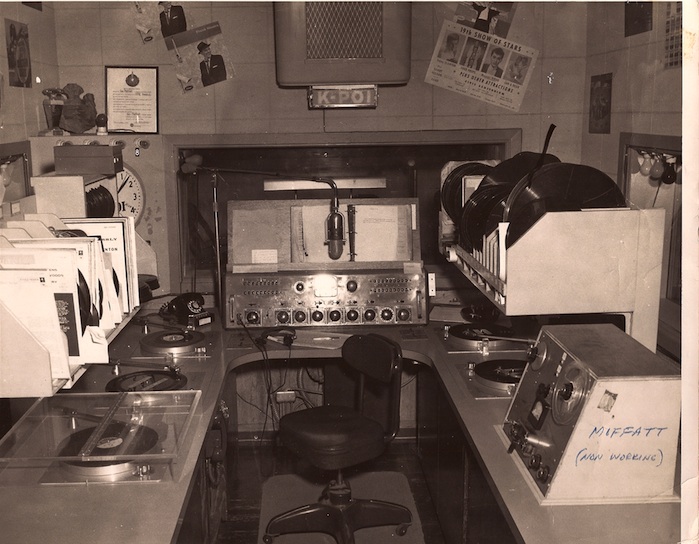
KPOI Radio Control Room, 1959


The faded photo above is from 52 years ago. It is of the KPOI Radio control room, from which Rock & Roll first blasted to all the Hawaiian Islands on May 18, 1959. I was the original Program Director, Production Manager, 6-9 am and 3-6 jock--we were called "The Poi Boys." When Honolulu’s first Top 40 station debuted, the Territory was still months away from Statehood.


The station, Oahu's third licensee, signed on as KHON, July 4, 1946. It was located at “The Gateway to Hawaii,” on 1701 Ala Wai, across a narrow street from the "fragrant" Ala Wai Canal.


Compared with 21st Century Waikiki, this was a sleepy neighborhood a half-century ago. Its word famous beach gloriously hosted the tourists who stayed in the ten or so hotels on Kalakaua Avenue, the main drag. Locals from “town” surfed, swam and tanned there. Those living in “far away” areas such as Makapuu, Waimanalo, Kailua, along the North Shore from Kahuku to Haleiwa and so on, went to beaches in close proximity to their homes.


Located on the Beach at Waikiki, the Outrigger Canoe Club lured members from about the island with its primo, private beach, restaurant and café, spacious locker rooms, showers, sauna and other stuff not available at the two major hotels located on the beach: The Moana (1891) and Royal Hawaiian (1928).


This was long before Waikiki became a bizarre conglomeration of visitor targets like Tijuana, Disneyland, Tokyo’s Ginza, teeming Hong Kong island, Times Square, Piccadilly Circus, La Vegas and the other post-World War II Schlockposts all competing for the Yankee Dollar.


But, aha, the Waikiki that saw the 1950s segue into the 60s was still vibrant in its sleepy Hawaiian way. It smelled of the perfume of Polynesia, not the noxious, foul fumes of heaving tour buses and delivery trucks that now clog its One Way streets.) Kuhio Beach offered up the sun-baked aroma of coconut oil, Mai Tai mix, beer, cigarettes and floral lei for a dime apiece. Their blossoms filled the air with, “The Fragrance of a million flowers,” which Johnny Noble serenaded in “The Song of Old Hawaii (1937).


By 1959 our town was catching up with the Really Big Island: jet airplanes, the first high-rise hotels (no time-share condos yet), souped up 1955-57 Chevy's, Long Playing albums, Hi-Fi, and all kine other things jerked us closer in synch with the Mainland. Still to come were live network TV programming (1966), FM radio (1961), Hawaii 5-0 (1968), our first elected Governor and members of Congress (1960), the arrival of Barack Obama, Sr. (1959), freeways (1970s), MacDonald’s (1968) …you get the picture?


In 1959 our 5000-watt KPOI transmitter (at 1380 KC on the AM dial) historically introduced the citizenry to the likes of the Everly Brothers, Chubby Checker, Roy Orbison, Connie Francis, Sam Cooke, Bobby Darin, Fats Domino, Ricky Nelson—and THE KING, Elvis Presley. Actually, he skyrocketed in Hawaii after performing two concerts at Honolulu Stadium in November 1957.


All these artists and scores of others performed here, mostly at the old Civic Auditorium on South King Street. (My all time favorite and friend was Screamin’ Jay Hawkins, who moved here for a while.) Each and every of those concerts was emceed by Hawaii’s first rock jock, “Uncle” Tom Moffatt (above, with Colonel Tom Parker.) Moffatt and I had each MC'd one of the early Elvis show.


My oldest radio friend (KGU, 1955) and original Poi Boy Moffatt remains active as the Pacific Rim’s top concert promoter, record label owner/producer and—he still hosts a live Saturday oldies program. [Note, top photo: the “Moffatt” note posted on the ancient reel-to-reel tape deck.] Old buddy Art Laboe could be the only older DJ still spinning the hits, and he started a decade before Moffatt and me.


As many have speculated, if only walls could talk; those odd canec walls in the cubicle shown above. And I don’t refer to the broadcasting activities that took place within. I mean the (pre-STS) drugs, sex and rock’n’roll that went down it that control room, most often in the Still of the Night.


I figure that before I took off for Southern California in 1962, to set up KMEN-San Bernardino and KMAK-Fresno, I spent close to 1300 hours from 1959-1963 in the booth pictured above. That equals having played and listened to an estimated 26,000 sides. By the time I was 25 I felt like I was hooked by IV to a juke box. The studio area was smaller than the cell in Halawa Jail, where I spent 30 days, in 1964. Yep, I was incarcerated for, get this, possession of three milligrams of marihuana [sic]. But the slammer, redolent with Lysol, Clorox and stale cigaretted smoke was not the stink hole of KPOI's communal studio "restroom."


The "Big Studio" could be seen through the window located behind the RCA console, above. In the 1940s Hawaiian performers from Gabby Pahinui to Genoa Keawe recorded in that large space. In 1959, Moffatt and I founded Teen Records (how cool, man.) Our first session involved five guys from Farrington High School in Kalihi: Rudy & The Royal Drifters (below). Two sides, featuring the first Rock/Pidgon records, were released as our first 45 single. I wrote both tunes, the immortal "Da Kine" and "'S Why Hard." They sold well -- perhaps concidentally with KPOI pounding out the record in max rotatation.


Now, anyone who spent any time in a radio studio, particularly in those Jurrasic Fifities, knows the clutch of clautaphobia and isolation, the air-conditioned coffee-and-cigarette aroma circulating through the room. And wow, the transmitter’s huge vacuman tubes, sparking and crackling, behind thick glass peep holes along the thing’s 40-foot width.


That shit was more terrifying than anything in Science Fiction. And movies where the villain is electrocuted.


Jocks then knew the exact length of the longest 45 r.pm. records—which averaged 2:10 minutes or so, back in that monophonic day—and, of much greater import: precisely how long it took to to make it from the deejay chair to the closest toilet seat. “Bathrooms” in most studio areas were used exclusively by the all-male air staff were more disgusting than the trenches of World War I. We considered it a fair situation, however, since the stench assured that no wives or wahine would come near the fetid lua.


But rather than dredge up memories of dozens of studios, from Macao to Miami to Munich to Modesto, I would rather focus here on the point of this blog: Advances In Technology: Wireless Transmission of Electric Impulses into which Sound Is Converted to Radio.


When I first received from Moffatt the above JPG (c. 2003) by email (c. 1971) via the Internet (c. 1980) to my iMac (c. 2010) I was blown far away. First, the content—that studio with whom I had a love/hate ambivilance—and secondly, how downright crude it all seems now. Then again, in 1959, push-button phones, fluorescent lighting, air conditioning—evertying incuding the “modern” swivel chair—they were all new amazements of the Space Age that Sputnicked to a start in 1957.


Now I must deal with this alphabet soup needed get this from me to you: USB, HTML, JPG, OS 10.6.6, SMTP, MGHz, MB, SDRAM, PCI, WWW, LAN, ISP, URL, etc., all of which make me SOL (Scream Out Loud!)


As for the old cinder block building, it ceased being a radio station in the 1980s. It was a gay gym for a time and then was taken over by the Hawaii Hotel Employees & Restaurant Employees Union, Local 5, as their blue-trimmed administrative headquarters. As such entities are wont to do, the union went through external and internal battles. Recent newspaper reports state that the labor group is in deep financial pilikia, with a multiillion Waikiki hotel in danger of defaulting. Today 1701 Ala Wai is posted with FOR LEASE signs.


Man, with all its karma, the place would make a helluva rock club, just a few blocks from the two-mile strip that comprises wonderful Waikiki. Meanwhile in the dreams of those of us who toiled within the place, we will never forget the monster mono Altec Lansing speaker cabinet, the iconic RCA 77DX microphones, the five QRK turntables, stacks of 15-inch electrical transcriptions full of commercials, the lone VU meter and the Stancil-Hoffman reel-to-reel tape deck -- when it worked.


1701 Ala Wai Boulevard, Honolulu 96815 - May 2011


Thanks much for reading through this. Please leave a Comment -- if you can figure out how to do it.


Kamis, 27 Mei 2010

"KHJ: INSIDE BOSS RADIO" RETURNS!

Boss Jock Charlie Tuna adapts to Boss Angeles traffic. This is one of the dozens of unpublished photos by Henry Diltz, lensman for 93/KHJ publicity pictures before he became one of the world's foremost photographers of rock stars for the past 40 years.

In response to the many requests for the book KHJ: INSIDE BOSS RADIO since it went out of print in 2002, we are reissuing the 445-page volume. For more info--and a one-hour collage of 93/KHJ promos--please go to: http://www.93khj.com/ Thanks to Don McCoy, Dave Sebastian Williams, Kevin Gershan, Carol Williams, Brian von Ahsen, Ed Kanoi and the others who have worked diligently to Bring Back The Book! Below is a portion of one page of quotes; the book is full of hundreds of these, based on dozens of interviews conducted exclusively for KHJ: INSIDE BOSS RADIO.

Ron Jacobs: I was hired at $15,000. We all were — are you kidding? $15,000, man? When I was fairly certain that I’d be around a while, I bought a new house at the top of Laurel Canyon, I was driving a new Cadillac. When I left KHJ I was making like 50 grand or something like that. But when I got there, money wasn’t the issue. Remember, two weeks before, I was in jail eating peanut butter and jelly sandwiches. And that wasn’t peanut butter or jelly. It was peanut butter and jelly all mushed together, take it or leave it.

Casey Kasem: Ron Jacobs and I became friends when he had asked to have a meeting concerning the possibility of my moving from KRLA to KHJ. As a matter of fact I think there were two or three meetings. We had a mutual respect for one another’s talent and hit it off. The only reason I didn’t go to KHJ was because the money I was asking for was much more than the salaries of the KHJ air staff — at the time I was enjoying success and making big money with my daily TV show and weekly dances. Ron couldn’t risk doing anything that might disrupt the great morale at KHJ or upset the DJs who were responsible for making his station #1. A few short years later, I called Ron and asked him if he would be interested in producing a countdown show, the Top 40 Hits in America. His immediate reply was, “Sounds great! Let’s get together and do it!” And with our associates, we did. And I’ve been counting down the hits ever since.

Gary Mack: As the rest of the crew was hired: Robert W. Morgan, Roger Christian, The Real Don Steele, Dave Diamond, Sam Riddle and Johnny Williams. We set about the business of getting organized. Ron Jacobs was brought in as Program Director--the best I’ve ever met.

Charlie Tuna: The Real Don Steele was the rock star leader of the Boss Jocks. Very mysterious, said very little off the air, but when he did, people listened. Sam Riddle was the businessman, always had a million outside deals going on in addition to his KHJ-TV show. It all paid off down the road; one of Sam’s productions was “Star Search” with Ed McMahon. Johnny Williams was the perfect all-night man, soothing voice, relaxed presentation and always right there with the quips and perfect feel for the format. No one could sound like he was having a ball during the really slow and lonely times any more than Williams.

Sam Riddle: When the time came to get ready for the new Boss format, I’ll never forget practicing on KHJ-FM so no one would hear me. Ron Jacobs said, “OK, you’ve got seven seconds to say what you used to say on KFWB and KRLA in forty-five seconds.” We had an engineer running the board. Dexter Young was my engineer and he took care of me. I thought: that’s fantastic. I’ll have more time to be on the phone to book Bobby Sherman concerts.

Gary Mack: It was grueling. Jacobs and Drake stood in the control room with an engineer while the future Boss Jocks practiced this new format. Every word and every nuance was critiqued on the fly. “More up! More energy! End up! Faster!” I remember the distinct odor of flop sweat. But every day got better, and we made our mistakes off the air.

Claude Hall: Bill Drake assembled a good staff. One of the smartest things he did was hire Ron Jacobs because Jacobs was a very, very hard-working guy. He’s extremely bright. Drake may not be that bright, but he thinks. He just sits back and thinks a lot. His major role, I think, in RKO during his time as consultant, was a thinker--as a brain to figure things out. A lot of people think Drake invented the tight play list, that he invented this and invented that. He didn’t. But like a genius (and the role of a genius takes in many different facets) what he was able to do was synthesize. Einstein didn’t “invent” E=mc2, he synthesized it. And this is what Drake did with Top 40 radio.

Ron Jacobs: When I got to KHJ I felt a rapport with Bill Mouzis. He was a pro who sensed what we would be doing in production, which was totally different from KHJ’s old-school sound. I asked Chief Engineer Ed Dela Pena if he could assign Mouzis to production. It was Mouzis who did all of the tedious razor splices. Mouzis sat there unconcerned when Morgan and I got into one of our screaming sessions about how he was ruining my copy — or how I was writing crap that a cave man couldn’t work with. Both of us running back to the “production library,” which was, at best, maybe 30 movie sound-track albums in a room where it was legal for us to touch turntables and argue some more. Morgan and I started our love/hate relationship in Fresno in 1962 and each of us knew that the other would be looking for any reason to provoke a confrontation. That was wonderful fun. It made us feel like we were “creative.” After a while, we were bringing in tons of money for RKO, more even than the mighty Channel 9. We could carry on, bellowing and slamming around and the suits just had to put up with it. (Laughs.)

Carol Morgan: I remember how important it was to Robert; he wanted Ron Jacobs there. He also got them to hire Don Steele. There weren’t too many people in radio that he really connected with. He loved people who were really bright and quick. Ron fulfilled something for him that he and I had always had between us up to that point.

Dexter Young: I worked mainly with Sam Riddle. I used to see Sam in the hallways. He was doing his TV show on Channel 9, KHJ-TV, but working for our competitor, KFWB, as a disc jockey. I used to ask Sam, “Since you have your TV show here, why don’t you have your radio show here too?” There had been a rumor that he was coming to KHJ and he finally did come with us. He and I became very good friends while working together. My wife and I were invited to his wedding.

The estimated shipping date is June 20, 2002.

Kindly order now to receive a first copy--and to receive your two complimentary CDs of killer KHJ promos.