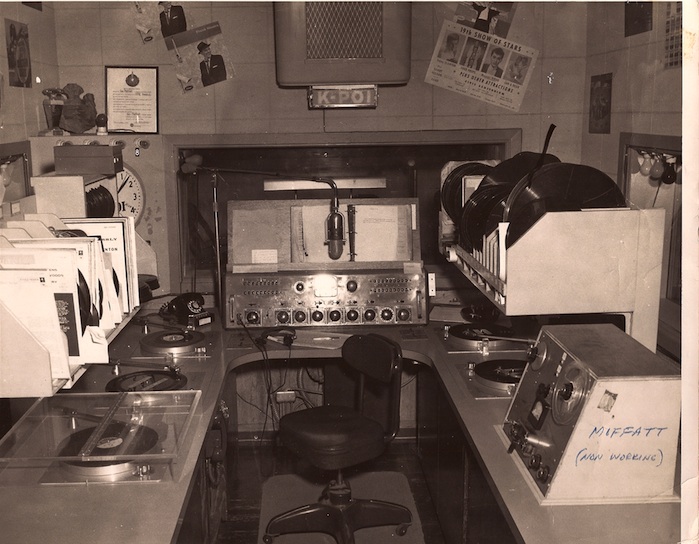
In April of 1955, while doing the all-night show, KHON disc jockey Art Bogard was busted by the Honolulu Police Department's vice squad. Charged with possession of "marihuana," how it was spelled in those days, he was given the choice of catching the first plane out of town or being booked and arrested.
Bogard played "Mixed Emotions" by Rosemary Clooney, packed it in at 6 a.m. and took off for Los Angeles.
Since I was "experienced" and worked for peanuts I became a professional radio person. Being the smallest fish in the smallest broadcast pond in the Pacific mattered not. I had one bare foot in the door. Thus began my broadcast "education."
In its nine years of operation KHON went from an enterprise charged with good will and great expectations to the bottom of what was then an eight-station barrel.
KHON was sold long ago by the idealists who built it. When the station opened in 1946 the Honolulu Star-Bulletin ran a story about Ralph Fitkin headlined, "New Radio Company's President is Son of Man Fabulous in U. S. Finance."
"The elder Fitkin, who started his career as an ordained Methodist minister, was a donor of several million dollars to philanthropy," the Bulletin reported. Well, neither prayer nor the family fortune could make a go of KHON.
A series of inept owners and silly format decisions took the station further down. By February 1954, the station was sold to B. R. Gardner, a mainland car dealer. More about him later.
When I was a 9-year-old kid prowling Waikiki I investigated this radio station located across from the canal at 1701 Ala Wai Boulevard. A corrugated tin-roofed shed ran along the back wall of the parking lot. Covered spaces were reserved for staff members. The choice stall was labeled "Aku." That's what it said on the plates of his new Caddy: AKU. From the mid-1940s J. Akuhead Pupule was the superstar of Hawaiian radio. The cigarette machine in the KHON lobby was stocked exclusively with Old Gold cigarettes, a loyal Aku sponsor.
The huge record library was crammed with neatly filed 78 rpm records sheathed in light-green, heavy paper sleeves (or "shucks" as they were called.) A single, giant monophonic speaker cabinet hung on the wall above a two-speed turntable.
During one summer on a kids’ expedition I toured the grand studios of Hawaii’s oldest station, KGU. The walls of this NBC affiliate were covered with lauhala matting. The dried, woven grass was attractive in a Polynesian way and served an acoustic purpose.
KGMB's modern facilities, appropriately shipshape for a CBS outlet, and the small but tidy KIKI broadcast booths were familiar to me from my experience doing teenage shows. But I wasn't ready for how bedraggled KHON had become by 1955.
Electronic components were replaced with cannibalized replacement parts. The weird canec walls were indented or missing large chunks of the stuff, which was made from the remains of burnt sugar cane. It was, indeed, a "previously owned" radio station.
B. R. "Brick" Gardner, the station owner, usually satisfied his alcoholic cravings while I did my "shift" from midnight to 6 o'clock in the morning. He often stopped by to inspect his station when the Waikiki bars shut down at 2 a.m.
I could deal with the drunken man's stumbling, burbling and stinking of booze. What transformed the scene into a surrealistic horror show were the actions of Gardner's spastic dog. It was one of those little, allegedly "cute," snippety canines. I didn’t know the animal’s name. It might have well been Little Shit Face.
There I was, trying to stay awake while playing music designed to lull insomniacs to sleep: Mantovani, Andre Kostelanetz, Stanley Black and other unctuous crap. The studio door would fly open without warning. In charged the inebriated Gardner, followed by his slurping, yapping, uncontrollable pet.
The dog’s cute tricks included nipping at me, farting wetly and pissing on everything. Then the mutt zeroed in on the turntable that was playing the disc on the air. The tiny monster jumped up on the cabinet, chased the spinning record and dragged the needle across the grooves.
This made that horrible noise—screeeeeeech—worse than fingernails raking a blackboard or the Terminatrix’s death grinds when she finally gets hers in “T3: Rise of the Machines.” The dozen or so KHON listeners blamed the racket on the operator, me, of course.
What could I do? Ring the dog's pencil neck and toss its owner into the Ala Wai Canal? That would leave me unemployed. It might be worth it just to watch Gardner go on the air drunk, alone in the studio with a dead dog. Unfortunately, the man was so intoxicated he couldn't tell the difference between "dead air" and whatever was (or wasn't) ringing in his stupefied ears.
So, I shrugged, cued up Jackie Gleason's “Music, Martinis & Memories,” featuring Bobby Hackett on trumpet, and prayed that man and beast would leave without an olfactory trace. But oh no. Often a reminder of their visit remained, nauseating the morning man with the odor of human vomit and/or dog dung.
It did not take long to realize that "Show Biz" was not all that charismatic.
# # #
There were several reasons why the KHON job appealed to me:
(1) I "learned while I earned." Dropping out of school fueled my desire to keep up with my erstwhile Punahou and Roosevelt classmates.
(2) Virtually all those kids would head for college in the fall, to prestigious Mainland schools. Some of the RHS kids, unable to afford even the University of Hawaii, would go off to work.
(3) Although I was paid only two bucks an hour, I was living with my parents in the new Aina Haina subdivision; I had little or no expenses. I traded in my 1932 Plymouth for a suitably "hep" vehicle, my first flashy car, a 1951 Pontiac Catalina convertible. After $50 car payments I still had money to throw around. A chocolate malt and a cheeseburger at Kau Kau Korner cost less than a buck. A bowl of saimin was 20-cents.
(4) While the dreary album tracks segued until sunrise I poked around office trash and shuffled through desk drawers and file cabinets to fathom the off-air aspects of broadcasting.
(5) I read talent contracts, purchase orders, advertising agreements, FCC communications, personnel memos, incoming résumés, management directives, engineering data, etc.
Combining (1) and (3), I reasoned, gave me the jump on (6), the major priority.
Ah yes, item (6), becoming a deejay and therefore getting girls.
In his autobiography, “Growing Up,” columnist Russell Baker, describes how, as a 19-year-old virgin and Navy cadet training in Pensacola, Florida, he overheard the experienced pilots discussing their manly exploits.
"...The madness of the mania clamped me in a terrible grip. This was inflamed to a white heat by the tales told by the Casanovas who infested the barracks.
"Listening to the talk I was paralyzed with envy and desire. There is scarcely a woman alive, it seemed, who could resist the urge to haul men down onto beds, car seats, kitchen floors, dining-room tables, park grass, parlor sofas, or packing crates, entwine warm thighs around them and pant in ecstasy."
This I also believed. At seventeen I took as Gospel the veteran deejays’ tales of sexual conquest. These were initiated, if these scoundrels were to be believed, by contact made with nymphomaniacs who wore out their scarlet nails dialing the KHON' request lines. These harlots panted seductive suggestions to the mellifluous-voiced (albeit sometimes homely and/or deformed) announcers.
My professional goals and steaming testosterone level quickly made (6) my top priority. Those adolescent cramped, groveling sessions while parked at Mount Tantalus above Honolulu's city lights, or "necking" at the Diamond Head Lookout watching the “submarine races” were over. I was, after all, a professional radioman. The perquisites that accompanied my status were there for the taking.
Soon enough, doing the all-night show, twisting "pots" (volume control knobs, technically called rotary step attenuators, in the RCA "teardrop" style) and throwing switches was neither novel nor gratifying. It was time for extra-curricular job benefits.
I was ready to move beyond operating "the board" (control console) and meet a torrid wahine caller. Most were Navy wives whose husbands had been out to sea long enough to make these women urgently crave male companionship.
Or so they claimed. The ladies requested tunes like Les Baxter's “Unchained Melody,” Joan Weber’s “Let Me Go Lover” or other romantic, pre-rock songs popular in the spring of 1955. Protracted phone conversations slowly segued from song solicitation to discussions of loneliness.
These "I-just-love-the-sound-of-your-voice, Honey," phone calls were precursors of today’s phone sex. Some women talked provocatively then waited while I introduced the next song; there were little or no commercials on the overnight shift. The simmering venting of restless lust resumed. The woman breathed louder and quicker, let loose a shuddering gasp, and then—hung up. I guess I served her purpose, but those sessions left me hot and bonered, staring at plastic knobs.
I decided to "qualify" female callers until I would encounter one ready to put her mouth where her sensual thoughts were. Logistically, I knew that I would have to find the proper rendezvous to meet my first amorous accomplice. Teenage longings notwithstanding, visions of headlines like "Local Deejay Shot By Enraged Navy Husband," encouraged me to be sensible.
The country had already been caught with its pants down at Pearl Harbor. I knew better than to tempt fate and allow the same thing happen to me.
Finally, I spent one night in a teasing dialog with a Chief Petty Officer's wife possessing the sexiest voice ever heard on a request line. She claimed to unfulfilled, dripping desire, not just for anyone, but for me. I arranged an assignation.
I was not anxious to cause my parents simultaneous heart attacks followed by a grim scene with me and my stuff thrown out onto Papai Street. What proof had I that the woman's husband was indeed serving our country, bobbing in a battleship somewhere in Subic Bay? I planned visual recognizance to check things out.
Mister Cool I was not as 6 a.m. and the “New Filipino Mabuhay Hour” approached. Based on the past hours’ burning banter all I could think off was my initiation into the world of the real disc jockey.
I was out the back door seconds after I gave the hourly I.D. Inflamed by visions of what awaited I jumped into my bright red Pontiac ragtop. Rubber smoked as I roared out of the parking lot. I raced up Kalakaua Avenue, turned ewa on Kapiolani Boulevard and headed for the designated gas station at Pensacola Street. I did a racing skid into the parking area, jammed on the brakes, rolled to a silent stop and—there it was! As promised, the 1948 green Dodge coupe.
My dream was about to come true. I was ready to encounter—a woman, not a girly-girl—a genuine woman. One who possessed a throaty, irresistible voice and whose words matched mine, urge for urge.
There, in the shade, following instructions was her car. Inside, the silhouette of the female I was about to hurl myself at.
I nonchalanted my way towards the car. It was painted Navy battleship gray. Which triggered a flash of un-American guilt. But that lasted no more than a second or two.
I pulled open the car door. My first reaction was that I had entered a rolling brewery. The auto's interior stank of alcohol, which was not or has ever been my thing. Then a saw her.
Too late. I realized that the radio thing works both ways. The women who fantasize about what a jock looks like based on the sound of his voice are no different from the salacious hustlers disguised as radio announcers who prey upon their sultry sounding female callers.
I was face-to-face with the anti-Marilyn Monroe. Jayne Mansfield in a fun house mirror. Brigitte Bardot blown up as big as a Macy's Thanksgiving Day Parade balloon.
As I sank into the passenger's seat, I saw that the woman was not only old—make that antediluvian in my teenage eyes and grotesque—she was also very drunk. Then she lurched at me and vomited in my lap.
Wishing it were a nightmare I could wash away, I ran towards the water hose and drenched myself. The alcoholic adulteress hung halfway out the port side of her car, gargling incoherently.
I drove off, ardor cooled, fantasy unsatisfied, clothes soaked.
It was back to Square One. Like the defecating dog scenes, it proved indeed that "Show Biz" was not all that charismatic.
I like to think that I learned from my mistakes. Thereafter, I would instruct a “date” to drive to a brightly lit gas station. If what I saw brought back memories of the Pensacola Puke I kept on driving. It left me lacking in gratification but it saved on dry cleaning bills.
# # #
Two decades pass.
After serving my time in Los Angeles radio I returned home in 1976. I realized that I would never catch up on what happened while I was gone, what happened to whom. But one day I was talking with Tom Moffatt. We first worked together at KGU in 1956. I asked Moffatt about Gardner, where’d he end up? Moffatt replied, “You didn’t hear about the fall?” Moffatt wasn’t certain of the details.
The story was bizarre enough to send me to the Hawaii State Library Archives in downtown Honolulu.
Gardner's propensity for nocturnal prowling had finally come to a fatal conclusion. Booze is not mentioned in the following account but I bet it was involved:
Hotel Fall Kills Kahala Man, 60
A school teacher fell to his death today from the ninth floor of the Kahala Hilton Hotel. Police believe Bryson Ross Garner 60, of 4788 Aukai Avenue, Waialae-Kahala, lost his balance and toppled off a beam connecting two balconies while trying to reach an acquaintance's room.
He fell 104 feet and landed on the sidewalk. He died instantly. His was the first fatal fall at the hotel. There were no known witnesses to the 12:18 a.m. fall.
Police believe Gardner was on the ninth floor to visit a friend whose room is on that floor.
Gardner had taught at Kalakaua Intermediate School since 1960.
Gardner formerly owned radio stations here and on the Big Island. His Honolulu station was KHON, now KPOI.
Before he moved to Hawaii in 1954, he owned a chemical firm and an automobile dealership in Tacoma, Washington.
# # #
A picture of the balding, old night crawler, looking dour and wearing a prim bow tie, accompanies this front-page story from the Honolulu Star-Bulletin of January 25, 1966. This is doubtless the way he was known to his students. (Since the photo is in black and white, there is no way of determining whether his eyes were bloodshot.)
In a morbid way, Gardner was lucky he did not survive his final late night adventure. Explaining to his students—or anyone else for that matter—-his odd way of reaching the room next door might have been a bit, er, awkward. In Honolulu's gossipy radio circle, it was rumored that Gardner's "acquaintance" was another man.
The next day's Honolulu Advertiser account of the odd event lists the age of my former boss and tormentor as 57, not 60.
Neither newspaper's account of the plunge mentions whether Gardner's faithful dog took the fall with him.
Damn.
Excerpted FROM DOO-WOP TO DUOPOLY
copyright 1988-2011 Ron Jacobs.